

If you’re a millennial or beyond, few things are as memorable as Sesame Street.
That said, I hadn’t thought about Sesame Street or its wonderful characters in a long time. Not until this conversation with Pasquale D’Silva.
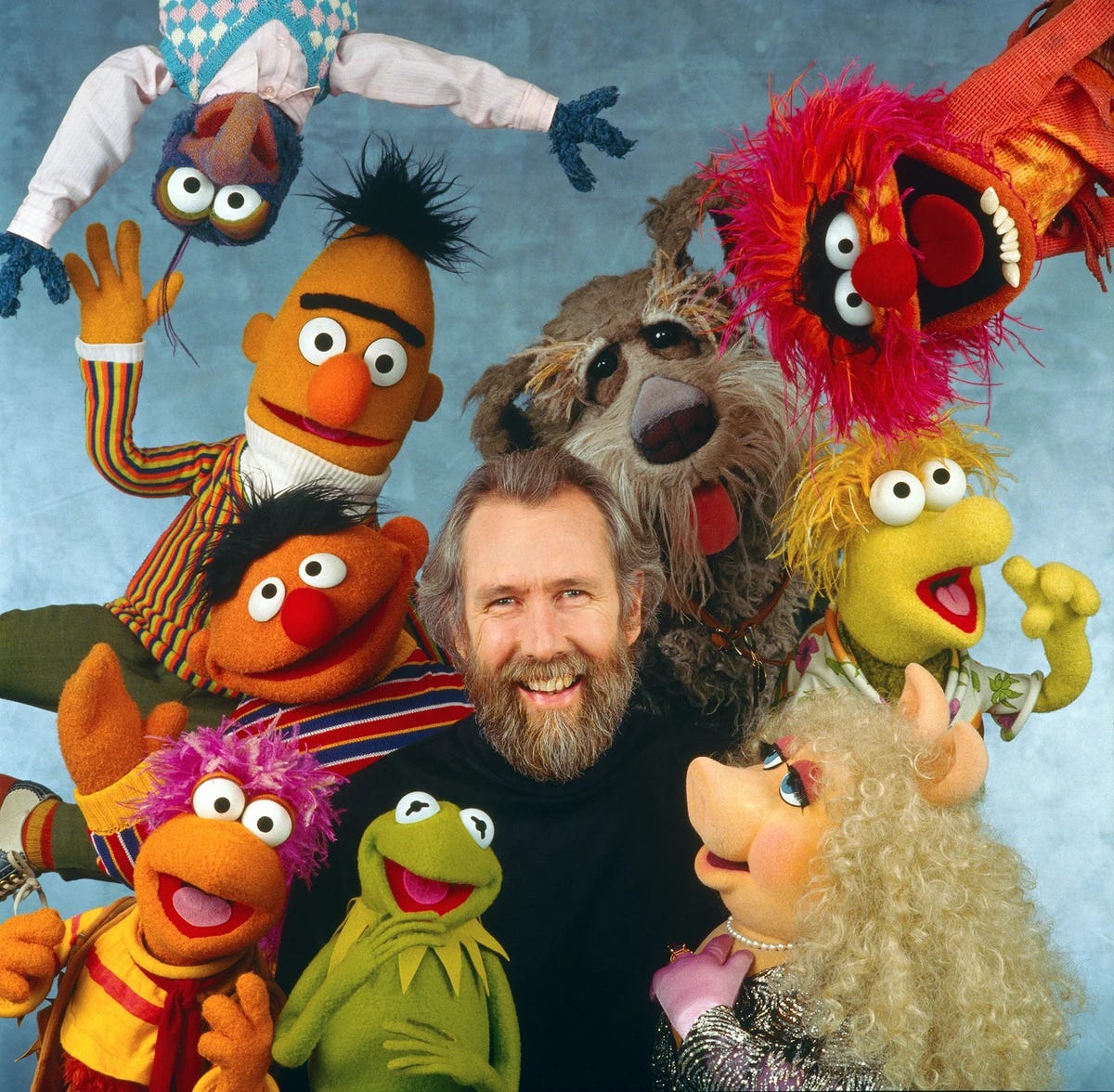
Pasquale is on a mission to recreate the magic of Sesame Street, but with the power of AI and robotics. In our convo, he waxed poetic about Jim Henson; his vision, his philosophy, and his blueprint for creating characters that deliver joy.
Pasquale is following Jim’s blueprint, but he’s adding a unique spin: the art of clowning.
Yes, you heard me. Clowning.
Sounds strange, but bare with me… It connects back to robotics; particularly, building robots we’ll actually want.
Pasquale’s mission sparked something in me. Perhaps because my daughter Chloe is turning one and becoming a sponge. Or perhaps, because this mission is as important as any other in the AI race.
So I wrote a letter to good ol’ Jim to explain why.
Dear Jim,
I hope all is well in Heaven and that you’re finding good company, including with all your closest friends: Kermit, Big Bird, Miss Piggy, and the whole crew.
Down here on earth? Boy, are things a changin’.
You’d be both thrilled and horrified by the possibilities.
On the plus side, AI is finally real and an entirely new form of puppet is on the horizon. Ones that will be in our homes, raising our children, supporting our elderly, and keeping us company.
On the down side, the engineers are at the wheel, not the artists.
While the result is mind bending technology, the felt experience is soulless. There’s no character, there’s no emotion, there’s no wonder, and as a result… there’s no connection.
These companies are wildly powerful and well resourced, but at times, misguided; driven by a race towards what we call AGI. Their priorities? More data, more compute, more agents.
What these companies really need is more Jim Hensons.
Fortunately, I found a sci-fi Jim in the making. His name is Pasquale and he’s following in your footsteps. His project is small, yet profound.
The goal: build characters and personalities into robots to make them interesting, fun, warm, and worthy of trust.
The proof of concept: via partnership with Boston Dynamics, he’s taken the Spot robot dog and turned it into a character with a real personality, called Spark.
In developing this character, your principles are a guiding light. But Pasquale is bringing in his own flavor that I think you’d appreciate.
It’s the art of clowning.
When I first heard this, it was a head scratcher. But as Pasquale explained, it made complete sense and I realized… Heck, all Sesame Street characters are little clowns in their own right. And damn… we could all use a bit more clowning in our lives, both personally and creatively; especially if we want to design intelligent, embodied systems that humans actually want to engage with.
But not by the mainstream definition… aka a silly (scary?), colorful, red-nosed, goofball.
Rather, by the more by the classical/academic definition. The one you’d find at ‘L’Ecole Philliippe Gaulier’, the famous clown school near Paris.
At Gaulier, the clown is simply the part of you that plays — without agenda, without technique, without the need to be impressive.
In this tradition, the clown is not a costume or a performance style. It’s a state of being. Specifically, it’s your inner child.
Said another way, to study the clown is to study oneself. And needless to say, no two selves (clowns) are alike. The clown is your clown — singular, unrepeatable, drawn from the most vulnerable version of you.
The French clown tradition also relishes the full range of emotions. People tend to think clowns are just one-note funny. But they can also be tragedy, despair, longing.
These elements, these states of being: vulnerability, emotional range, individuality… They all lie at the heart of the characters we love most.
In imbuing robots with character, Pasquale takes the definition a step further. He considers the clown a ‘social technology’ for breaking the frame.
It’s a character device, whose function is to enter a scene and make everything around it visible in a new way. By introducing the absurd, the clown recontextualizes the normal.
Suddenly people see the script they’ve been running, the NPC loop they’ve been stuck in, and they have permission to step out of it.
More specifically, Pasquale would say the clown is the thing that reaches the inner child before the adult has time to intercept. It bypasses the thousand layers of social programming — the system prompt of adulthood — and connects directly with whoever the person actually is underneath it all
My favorite idea from our chat? The clown as a presence, not a performance.
You don’t need to do anything elaborate. You just show up — slightly absurd, fully open, entirely present — and the field opens around you. People approach. They drop their guard. They get weird and real and human in ways they wouldn’t otherwise allow themselves. Kind of like how people behave with a cute and cuddly dog.
This is why Pasquale started with Spark. The clown is a dog in human form.
Dogs are radically present, they wear their hearts on their sleeves, they play without agenda, they connect without pretense. That’s the spirit of the clown. Not a joke machine. Not a performer trying to be funny. Something closer to a being that simply... is, fully, in front of you. And in doing so, gives you permission to do the same.
In our convo, Pasquale gave a powerful example of these effects in action.
You might have seen the movie Patch Adams. It stars Robin Williams, playing a ‘clown doctor’.
Turns out, Patch is a real person (news to me), who becomes a clown when interacting with patients. He’s well into his 80’s now and still practicing!
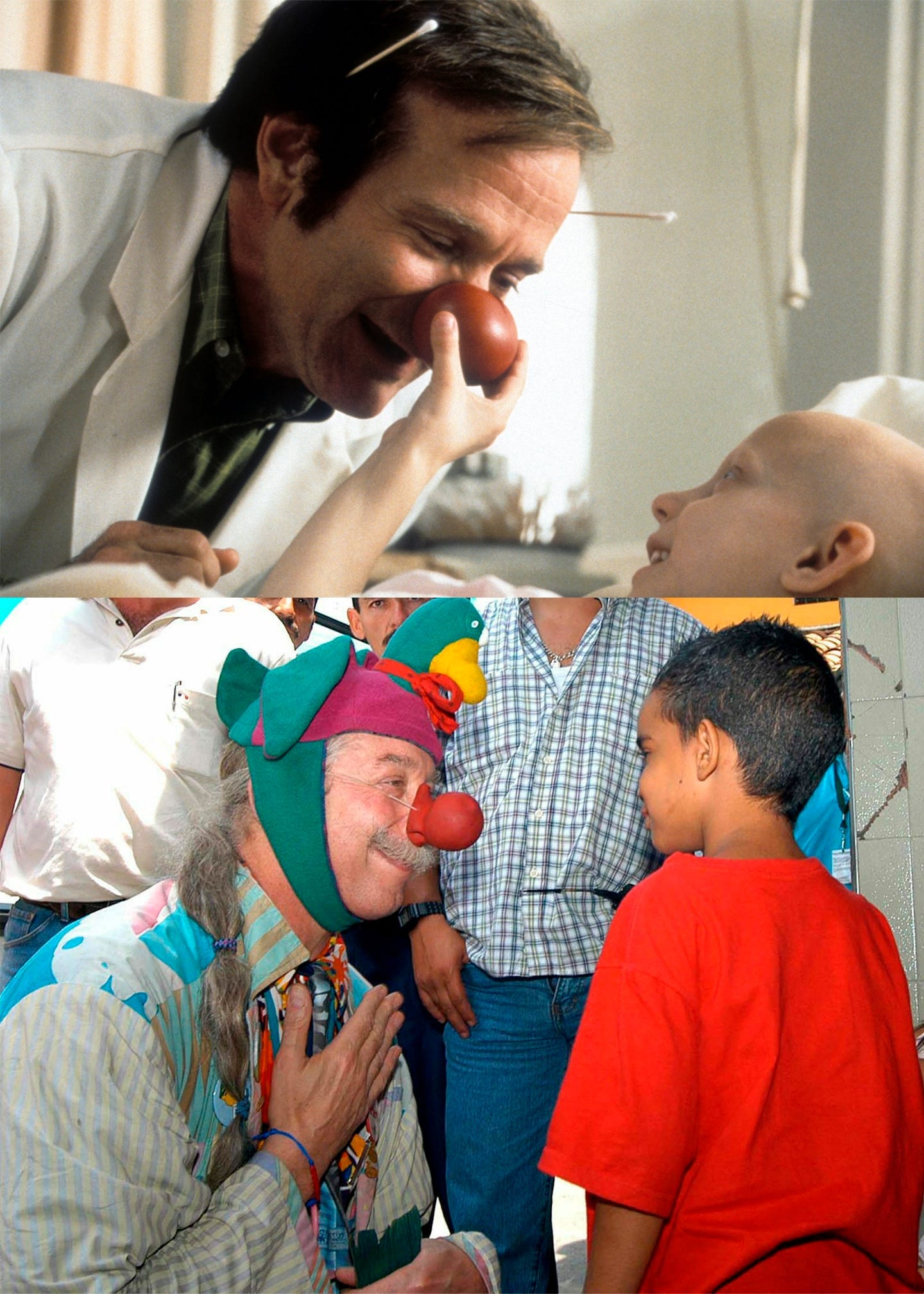
Patch’s approach was simple. When he first walked into a hospital, he noticed something the doctors couldn’t see from behind their clipboards: the patients weren’t just physically sick. They were psychologically abandoned.
The medical system treats the body like a biological computer — identify the problem, run the fix, send them along. It’s efficient and transactional. And for someone lying in a cancer ward or spending their final weeks in hospice, it’s utterly insufficient.
So Patch showed up differently. In clown. With warmth. Meeting people where they actually were, not where the chart said they should be.
The exemplar scene in the film involves a Vietnam veteran. He’s prickly, guarded, and possibly dying; the kind of man who’d sooner stare at the wall than let a stranger in. When Patch first visits, he shows up as a clown. The guy screams and shoves him out the door.
Most people would leave it there. Not Patch. He went away and asked himself a different question: what does this person actually want to talk about that nobody else will talk to him about?
The answer was death.
So Patch came back dressed as an angel — halo, wings, the whole bit — and started reading him poetry about heaven. And something cracked open. Because that was exactly where the veteran’s head already was. Patch didn’t try to cheer him up or distract him. He just got on his level. Fully. Without flinching.
That’s the thing Pasquale is pointing at; the clown, done right, isn’t performing for the audience. It’s finding the other person’s frequency and meeting them there. It’s presence over performance. And in a world with AI beings in our hospitals, our homes, our most vulnerable spaces… that distinction is everything.
So, Jim… despite the risks with robotics, fret not. There are people like Pasquale who are on the right track; artists who understand the full range of human emotion, the centrality of characters, and their ability to make us feel something. And this, this idea of feeling something… this is the greatest lesson we can take from your work. Your characters have such an internal coherence, emotional range, and distinctive personality that the audience forgets they’re watching a piece of foam, they experience empathy, and they start rooting for them like they’re real.
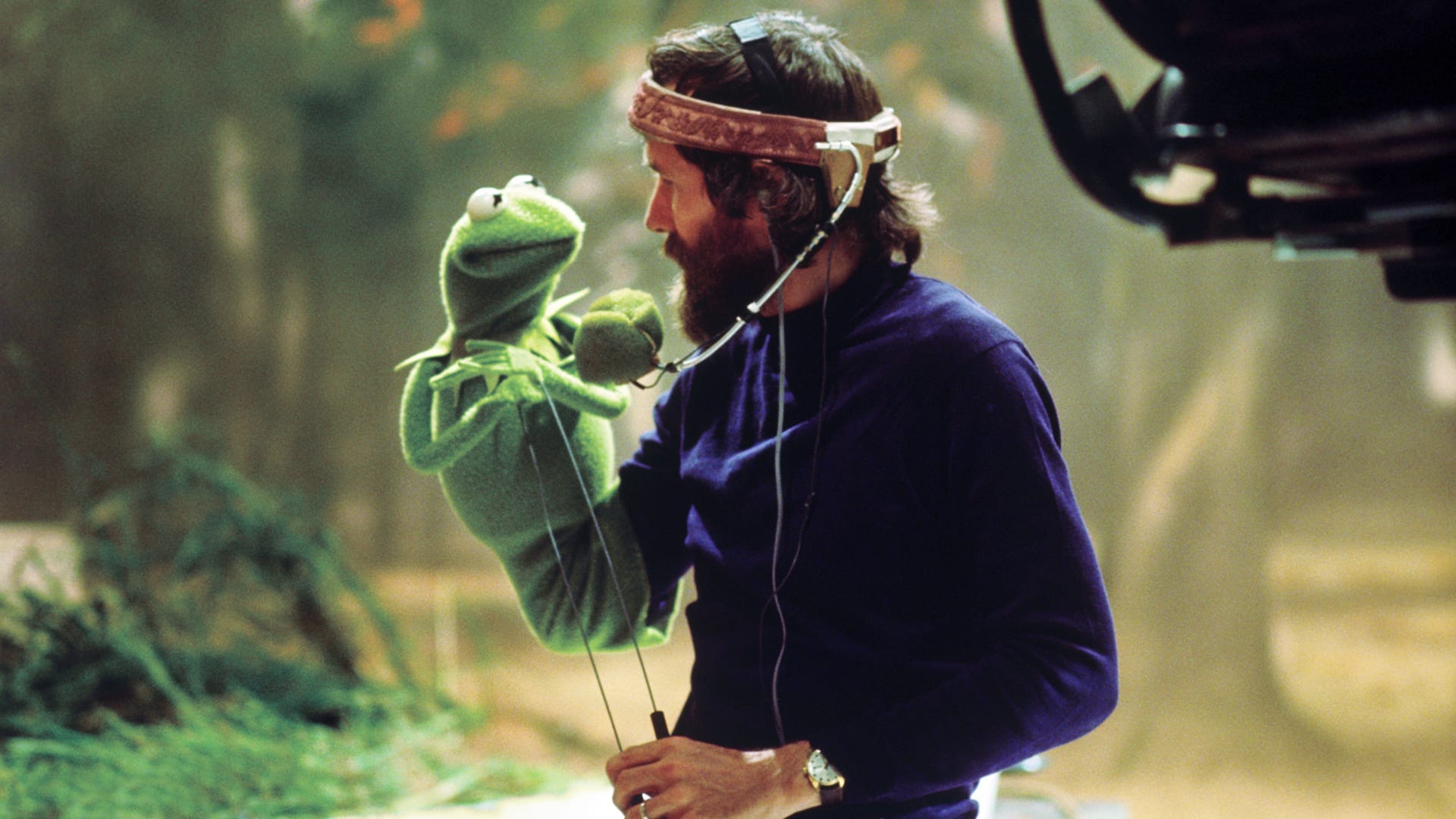
Kermit wasn’t a prop. He had anxieties. He had hope. He had a particular way of carrying himself through a world that was constantly overwhelming him. We love him because we recognize something true in him.

The body of the puppet, the aesthetics, the movement, all of it matters. But what animates it, what makes it feel alive, is the inner life. Strip that away and you have a very well-crafted object. Keep it and you have a being. Beings that elicit joy.
But joy wasn’t just an experience for you. It was a mechanism.
You believed deeply that joy, wrapped around warmth, humor, and delight, was the most efficient delivery system for everything important: empathy, learning, difficult truths, social values.
People don’t realize: Sesame Street did rigorous research and designed the show around measurable educational outcomes. It just never felt like it, because joy was the wrapper around everything. The lesson arrived before the audience knew they were being taught.
And in these lessons, you never talked down to them. Children especially. You believed they were capable of grappling with real complexity — grief, conflict, difference, fear — if it was given to them through characters they trusted and in a container that felt safe.
The clown and the puppet both serve this function. The absurdity creates permission. Once you’re laughing, your defenses drop, and the real thing can get in.
So, dear Jim, here’s to hoping robots can do the same. I’ll keep you posted on the progress.
Sincerely,
Evan
Hope you enjoyed this reflection on social robots. If so, subscribe below! More to come.